Categories
Uncategorized

Renters Insurance Simplified

Renters Insurance Simplified

Are you one of the 37 percent of renters who have a renters insurance policy? Whether your rental agreement requires it or you make the choice to protect the contents of your rental property, this type of policy can provide peace of mind. It can come in handy if you face unexpected situations, like theft or fire, or if an individual is injured while in your home.

But do you fully understand what the policy covers and what to expect should you file a claim? Here’s a breakdown of a few important points.

Replacement Cost Value vs. Actual Cash Value
There are two choices when it comes to how renters insurance values belongings. Replacement cost value determines the amount paid out for a claim based on the present-day cost of buying the same item. Other policies may use actual cash value (ACV), which takes into account depreciation due to normal wear and tear. This type of coverage will pay out less than current market value.

Deductibles
A deductible is an out-of-pocket amount a policyholder is responsible for when a claim is filed. In general, the higher the deductible, the lower the monthly insurance premium. Once the deductible is met, the insurance company handles the remaining cost.

Discounts
Most insurance companies offer discounts if you bundle renters insurance with other policies, such as auto insurance. Safety equipment, like fire alarms and security systems, may result in a reduced rate. Age, good credit and a claim-free history are other factors that insurance companies may consider for discounts.

Umbrella Policies
If after a careful inventory of your personal possessions and net worth you determine you need a higher degree of liability coverage, you may decide to purchase an additional umbrella liability policy. This option provides coverage on top of other policies, kicking in once those have been maxed out.

Categories
Uncategorized

What Is Usage Based Insurance? (Ubi)

What Is Usage Based Insurance? (Ubi)

The new hot button in the auto insurance world is now Telematics, aka Usage Based Insurance (UBI). But what is it?

Per Wikipedia: Usage-based insurance(UBI) also known as pay as you drive (PAYD) and pay how you drive (PHYD) and mile-based auto insurance is a type of vehicle insurance whereby the costs are dependent upon type of vehicle used, measured against time, distance, behavior and place.

The basic thought on usage based insurance is to charge a more exact premium for the specific risk.

 You may have seen adds from Progressive Snapshot and Allstate Drivewise stating how they can save you money by using their program.

This form of rating is still considered to be in it’s infancy and most of these carriers offer very nice up front discounts just to get started with their program, on average around 5-10%. After a set period, the company will then determine what your ongoing discount should be based on the factors their program measures. If you decide that you no longer wish to use this service, you can discontinue at any time.

What do the insurance companies measure you ask? Most want to know the time of day you are driving, the later at night and early morning hours are given less of a discount than other hours. Some also rate on hard breaking and/or fast acceleration. Others might measure the number of miles driven or location driven to determine your future discounts.

UBI devices differ from company to company. Most plug in to your vehicles diagnostic port. One company has even switched to using an app you install on your smartphone to measure their preferred data. Either way UBI devices or apps are not hard to install. (Companies that use the plug in devices, most will require that you return the device at some point or face a one time cost in the vicinity of $50-100 for not returning the device.)

Thank you for your interest in Usage Based Insurance and Taylor & Associates, if you are ready to begin a car insurance quote  we would love to help you find the best fit of coverage and premium. As an independent agent we offer several options for auto insurance that will give a discount for using telematics. These include Allstate Drivewise, Progressive Snapshot, The Hartford, State Auto Safety 360 and Safeco Insurance RightTrack. If you would like to see what you can save for being a good driver, contact us by phone (937-962-2123), email or click here.

Categories
Uncategorized

Tips For Parents Adding A Teen Driver To Your Insurance

Tips For Parents Adding A Teen Driver To Your Insurance

According to the Department of Transportation, more than 40 percent of young adults age 19 and younger are licensed and on the road. These teen drivers face crash rates nearly three times higher than those of drivers 20 years of age and older, and those rates climb even higher at night and when teen passengers are present. Statistics like these help explain why younger drivers can be more expensive to insure.

If you’re looking for ways to offset the increase in annual premiums after adding a teen driver, take note of these possible cost-saving measures.

  1. Include them on an existing policy.
    If your teen will share the cars you already own, you may save some money by assigning them to the vehicle that’s the least expensive to insure.

  2. Buy your teen an older vehicle.
    If your new driver will need his or her own car, you can generally get lower rates by putting them in an older, used model. Check the Insurance Institute for Highway Safety’s (IIHS) list of vehicles with lower auto insurance losses for more information.

  3. Take advantage of good-student discounts.
    Some insurance companies offer a discount to students who make and maintain good grades. The assumption is that if students are responsible with their schoolwork, they’re more likely to drive responsibly as well. This discount could be worth hundreds of dollars in some circumstances. Make sure your child knows the value of good grades.

Still, insuring a teen driver isn’t all about cost. Most parents are also concerned about their child’s well-being on the road. Keep safety in mind when car shopping, and check out the used vehicle recommendations from trusted sources like Consumer Reports.

Require additional safety measures? Investigate technology like monitoring devices that let you supervise your child’s speed and location or cell phone signal blockers that prevent calls and texts while the car is in motion.

Contact us to get some additional tips.

Categories
Uncategorized

Equipment Breakdown Coverage

Equipment Breakdown Coverage

Equipment Breakdown Coverage

Celina Insurance Group explains Equipment Breakdown as: Protection against unexpected repair or replacement costs due to mechanical, electrical, or pressurized systems breakdown.

Western Reserve Group adds: It Covers What Most Homeowner Insurance Excludes. Most homeowner insurance policies don’t cover the cost of repairing or replacing essential equipment in your home when it breaks down. Extended warranties? They’re often expensive, hard to manage, and usually cover just one piece of equipment.

Homeowner Equipment Breakdown coverage offers a simple, comprehensive and affordable solution that covers what most homeowner policies exclude.

What does the typical homeowner need to know about Equipment Breakdown Coverage (EBC)?

1. It covers things in your home like heating and air to refrigerator, water heater and water softener for breakdowns in electrical, mechanical or the pressure system.
2. It has a deducible. As with any other structure/content coverage on your policy, a deducible will apply to EBC. That means that small repairs may not be covered. Deducible will vary by company and policy. Be sure you are aware what your policy offers.
3. It will repair if possible and replace only if absolutely necessary. Not all failures are complete losses just like not all fires require the house to be completely rebuilt. If the equipment can be fixed for a cost less than the replacement EBC coverage will simply repair what you have. 
4. Replacement, if necessary, will be with comparable type and quality. Keep in mind that if you have a $700 refrigerator, that is what insurance will pay if you need a replacement. There are usually options when it comes to this. Most insurance coverage will allow the homeowner to upgrade to a better/higher cost product at their own expense. So if you want to replace that $700 fridge with a $3000 one, you can but it will cost you the policy deducible plus the difference out of pocket.
5. Equipment Breakdown is not a maintenance policy. EBC is not for items that simply wear out. Wear and Tear is something that is excluded by EBC. 

EBC coverage varies from one carrier to the next and is not offered as an optional coverage by every insurance company on their homeowner insurance policy. 

To discuss if Equipment Breakdown Coverage is right for you, please contact us by email or at 937-962-2123.

Western Reserve Group Insurance EBC Brochure

Western Reserve Group Personal Insurance Brochure

Categories
Uncategorized

Why Do I Need Renters Insurance

Why Do I Need Renters Insurance

Why Do I Need Renters Insurance???

Some people mistaking think that Renters Insurance is not needed because their landlord already has insurance on the house. This can be a huge mistake. While it is very likely that your landlord does have coverage on his building, this coverage does not provide coverage for the renters stuff. 

What would it cost to completely replace everything you own, your clothes, furniture, appliances, computer, smart phone and tablet? Probably tens of thousands of dollars. How financially devastating would it be if your apartment or home were to be destroyed by fire and all of your stuff was to be gone in the blink of an eye? Where would you live? Who would help you with getting your stuff replaced, fixed or cleaned?

There is an easy way to make sure this doesn’t happen to you. Purchase Renters Insurance from your local, independent, Trusted Choice Insurance Agency. Renters Insurance usually doesn’t cost much, normally only $20-$40 per month. 

Renter’s Insurance protects you by covering your contents for things such as fire, theft, wind and water damage. Most policies will provide some sort of option for replacement coverage making sure your stuff is replaced with brand new items. Replacement coverage is extremely important in the case of major losses where large amounts of your contents are damaged. Replacement cost coverage can save you countless thousands of dollars that may occur otherwise due to depreciation.

There are multiple benefits to having renters insurance. Not only will your contents be covered but you will also get liability coverage for you and your family. What good is liability coverage you ask, it can be even more valuable than the contents coverage. For instance, the average renters insurance covers somewhere between $25-$75,000 worth of contents while the liability protection provided by the policy is most likely $100,000-$300,000.

Liability coverage will protect you from financial losses that can come in the way of lawsuits or other legal actions against you or your household. Say you have a guest over to your home and he or she trips on a toy that your son has left lying on the floor. After many hours of painful and very expensive surgery, your friend is released by the doctor after months of physical therapy. Liability coverage along with Medical Payments coverage of a renters insurance policy will help cover the costs of the medical bills and help protect you from legal actions associated with this type of accident.

Liability from your Renters policy can also protect you while you are away from home. Say you were at the grocery store and you were in a bit of a hurry to get your shopping done so you make it to your kids sports practice on time. If you were to come around the corner with your cart and knock poor granny over and break her good hip, your coverage will help you pay for her medical bills and could help keep you out of a lengthy legal suit.

When discussing Renters Insurance with your agent, make sure you explore the following items.

1)    How much contents coverage should I have?
2)    Does this coverage give me replacement cost of my stuff?
3)    What deductible should I choose?
4)    How much liability do I need?
5)    What optional coverage items should I consider and how much do they cost to add on? Water backup, Identity Theft Protection, Earthquake or Special Scheduled Items like Jewelry or Antiques.
6)    Can I get a discount for having more than one policy with the same company? (Bundle, Multi-Policy/Multiple Policy..Whatever that company calls it.)
7)    How reliable is this insurance company if there is a claim? Are they easy to work with?
8)    What part will the insurance agent and the local agency play in the claims process?
9)    Will everyone in my home be protected? (This is of major importance if all the people in the home are not related. Roommates and live-in significant others for example.)

If you fall into any of these categories, you may need to consider more than your standard Renters Insurance policy.

1)    You operate a business from your home.
2)    Your residence is ever part of a sublease or shared use like Airbnb, GuestHouser or used as a vacation rental.
3)    If your contents are used for professional purposes like tools for your work or musical instruments for your break out band.
4)    Contents you have somewhere else like a storage unit or a friend’s basement that add up to more than 10% of your contents coverage limit, may need to have extra or extended coverage.

Nearly everyone that rents a place to live, whether it be an apartment, a house or a mobile home, will need some type of Contents Insurance / Renters Insurance Coverage. Even though Renters Insurance can be a very basic form of insurance protection, it is best to have the advice of an insurance professional.

Please contact Taylor & Associates Insurance Agency for more information. 

Categories
Uncategorized

Does Your Policy Extend To Your College Student?

Does Your Policy Extend To Your College Student?

Nowadays when teenagers move out of their childhood homes and onto college campuses, they often take a lot of technology with them. From laptops, tablets and smartphones to gaming and stereo systems, it’s estimated that two roommates in a single dorm room move in with approximately$6,000 worth of electronics between them, and that’s not counting other valuables.

What if your new college student forgets to lock the door or accidentally leaves belongings unattended? Theft is one of the most common crimes on college campuses, and replacement can be costly. To avoid this, look into your current homeowners or renters insurance policy to see what coverage may extend to college students.

Coverage and On-Campus Living
In most cases, a parent’s homeowners or renters insurance policy provides some coverage for a dependent who is enrolled full-time and living on campus. Still, it’s important to note that there could be a limit to the amount of off-premises belongings one can claim. For example, some policies may cap coverage at 10 percent, so if a parent’s policy has $150,000 worth of coverage for their belongings, roughly $15,000 could be used to replace possessions outside the home.

And if a child is living off campus?
Once a student moves off campus, they’re less likely to be covered under a parent’s insurance policy. In this situation, parents might consider purchasing a separate renters insurance policy for the college student or opting for specific stand-alone policies for high-cost gadgets and electronics.

Get a quote on Renters Insurance.

Categories
Uncategorized

Homeowners Insurance Coverage Forms. Ho3 Vs Ho5

Homeowners Insurance Coverage Forms. Ho3 Vs Ho5

You may think that all Homeowners Insurance is created equal. Most homeowners believe that as long as the coverage limits and deductible match, a policy or quote must be the same. This is usually not the case. Many homeowners policies or quotes vary greatly from one to the next. One of the differences between homeowners policies is whether coverage is provided on a HO3 or HO5 form.

The HO3 is by far the most widely available policy form and should generally be considered the minimum coverage requirement when purchasing a homeowners policy. The HO3 Form covers a broad range of property types, but offers a more limited coverage for your personal belongings as detailed below:

HO3

HO5

Dwelling Coverage Type

Open Perils

Open Perils

Contents Coverage Type

Named Perils

Open Perils

Open Perils – Insures against all causes of loss that are not specifically excluded

Named Perils – Insures against a list of specified causes of loss and is therefore more restrictive by definition.

Here is a list of the named perils that limit the personal property coverage on a HO3:

Theft

Fire or Lightning

Explosion

Smoke

Freezing

Vehicles

Falling Objects

Volcanic Eruption

Windstorm or Hail

Riot or Civil Commotion

Damage caused by Aircraft

Vandalism or Malicious Mischief

Damage due to weight of Ice, Snow, or Sleet

Sudden & Accidental Tearing Apart, Cracking, Burning, or Bulging

Sudden & Accidental Damage from Artificially Generated Electric Current

Accidental Discharge or Overflow of Water from Plumbing, AC etc.  

HO5 Difference

The HO5 has less limitations than the HO3, adds new coverage, and expands some of the existing coverage such as a higher limit for jewelry and business personal property. Many of the coverages that are extras on the HO3 may be included on the HO5.

Which should you choose?

Even though the HO5 will cost a bit more, if you qualify for the HO5 it is the usually the best choice if you want the broadest coverage. Not only does it provide more coverage, but can also simplify the claims process by removing some ambiguity.

Never assume that you are getting an apples to apples quote. The HO3 vs HO5 difference is just one of the many differences you might find when trying to compare quotes or policies. It is important to know what you are getting. Ask your agent to explain the types of coverage and the options that you have on your policy and verify that you are getting equivalent coverage if you are reviewing a quote with a new carrier. =
If you would like to Contact Us or Get a Quote, we would love to help you with your Homeowners Insurance.

Categories
Uncategorized

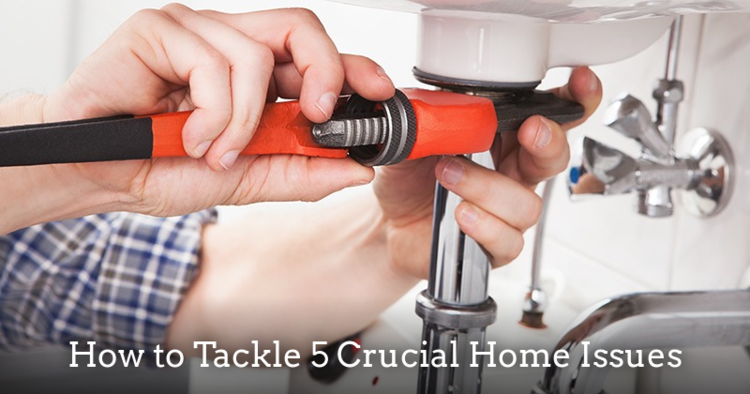
How To Tackle 5 Crucial Home Maintenance Issues

How To Tackle 5 Crucial Home Maintenance Issues

Maintaining a home, especially an older one, can be expensive. According to experts, homeowners should be prepared to spend roughly one percent of their home’s value every year on maintenance and repair. Want to keep some of that money and save yourself from common predicaments? Get familiar with these simple fixes and useful skills.

  1. Repair a leaky faucet.— This issue often relates to worn or disintegrating parts. First, shut off the main water supply, then remove the knobs and check the washers, stems and O-rings for signs of damage. Take the suspected culprits with you to the hardware store to get exact replacements.

  2. Stop a running toilet.— Remove the lid to the tank and inspect all the parts. Check the flush lever, rubber flapper, lift chain, float ball, pump and overflow tube. A running toilet usually requires a simple adjustment or replacement of a single part.

  3. Clean the gutters.— Remove leaves and debris from gutters at least twice a year to prevent damage to your home’s foundation, siding and landscaping. There are various methods and tools you can use to clean them out; in most cases, you’ll need a ladder, gloves and eye protection.

  4. Open a garage door when the power is out.— Locate the (usually red) cord, suspended from the ceiling-mounted operator. With the garage door closed, pull the cord to disengage the door from the motor. This will allow you to manually open and close the garage door by sliding it along the track.

  5. Remove a stripped screw.— If a screw keeps slipping while you’re trying to remove it with a screwdriver, stop immediately to avoid making it worse. Put a rubber band or a piece of steel wool over the screw and then try to remove it. If that doesn’t work, you can use a screw extractor.

Master these essential homeowner skills and keep the money you would otherwise spend on simple home maintenance.

Go beyond maintaining your home and protect it with home owners insurance from Taylor and Associates.

Categories
Uncategorized

Credit Score/Insurance Score And Insurance

Credit Score/Insurance Score And Insurance

Your credit WILL have a huge impact on your insurance rates. It is not out of the question that an individual on the lower end of an insurance companies score could pay twice as much or more than someone at the upper end of the scale. Insurance companies have determined that various credit indicators for an individual will help them determine how likely that person is to make a claim. This “insurance score” is not the same thing the bank uses to determine loan eligibility but rather a special model that the insurance company has had developed just for them.

Be not dismayed. Not all insurance carriers use the exact same model, therefore if one insurance company seems to be too high you can shop around a bit and see if there is another company that may score you more favorably. Better yet, have your insurance checked by a local, independent insurance agent. Independent agents represent multiple companies and have access to rates of several carriers to check which is the best in your particular circumstances. This is just one of the many great reasons to use a local, independent agent.

Had major change in your credit standing, you should know that in the future you can ask your carrier to reevaluate your insurance score if you have made significant improvements in your overall credit score. Don’t get in a hurry though, although credit scores can drop like a rock seemingly over night, they take forever and a day to move the other direction. If you have worked hard over time to get your credit back in shape, then by all means ask your agent to have your score with your insurance company reevaluated.

As always, remember that price is not the only consideration when picking an insurance carrier. Customer service, claim service and most of all coverage should be considered when deciding what company you will trust to protect you and your assets. Consult a local, independent insurance agent and let them know that you are considering more than just the price.

If you would like to  Contact Us or  Get a Quote, we would love to help you with your Homeowners Insurance.

Taylor & Associates Insurance Agency is proud to support our local community and the state of Ohio and Indiana with quality insurance coverage from reputable insurance companies like ALFA Insurance, Allstate Insurance, Celina Insurance Group, Dairyland Insurance, Progressive Insurance, The Hartford Insurance, Western Reserve Group, Safeco and State Auto. We provide car insurance for the Tri-County area including Lewisburg, Brookville, West Alexandria, Eaton, Eldorado, New Paris, West Manchester, Arcanum, Greenville, Richmond, Preble County, Montgomery County, Darke County, Wayne County IN.

Categories
Uncategorized

Understanding Your Insurance Policy Basics

Understanding Your Insurance Policy Basics

Some of us have home or vehicle loans that our banks require us to have coverage on our homes and cars and most of us live in states that mandate liability insurance on our automobiles. Still, it’s important to understand a few basic principles and common terms when signing up for an auto or homeowners policy.

Insurance Premium— You can mentally substitute the word “premium” for “price” here. In other words, your premium is the amount of money you pay for your policy. Generally, these payments can be made monthly, quarterly, semiannually or annually.

Lapse— If you fail to pay your premiums at the subscribed time, you’ll experience an interruption in coverage known as a lapse.

Deductible— Your deductible is the amount of money you’ll be expected to pay out of pocket before your policy will cover or reimburse you for any damages. Typically speaking, the lower your deductible is, the higher your premium costs will be.

Exclusions— Just because you have a homeowners policy doesn’t mean all items, conditions and circumstances are covered. Some natural disasters such as floods are commonly excluded. And if your home is damaged as a result of neglect or failure to properly maintain it, any related claims could be denied. Be sure to read your home insurance policy thoroughly to see what is and isn’t covered.

Comprehensive & Collision Coverage (Auto)— Commonly referred to as full coverage, this type of plan goes beyond the minimum required coverage. Where basic liability primarily protects other cars in the event of a collision, comprehensive & Collision coverage goes further, also insuring your vehicle against damage, whether it’s due to a traffic accident or stormy weather.

Understanding the basics (and considering if there have been any recent changes to your situation), is beneficial, especially if the need for a claim arises.